AI · ForecastingFull-stack
AI4Energy
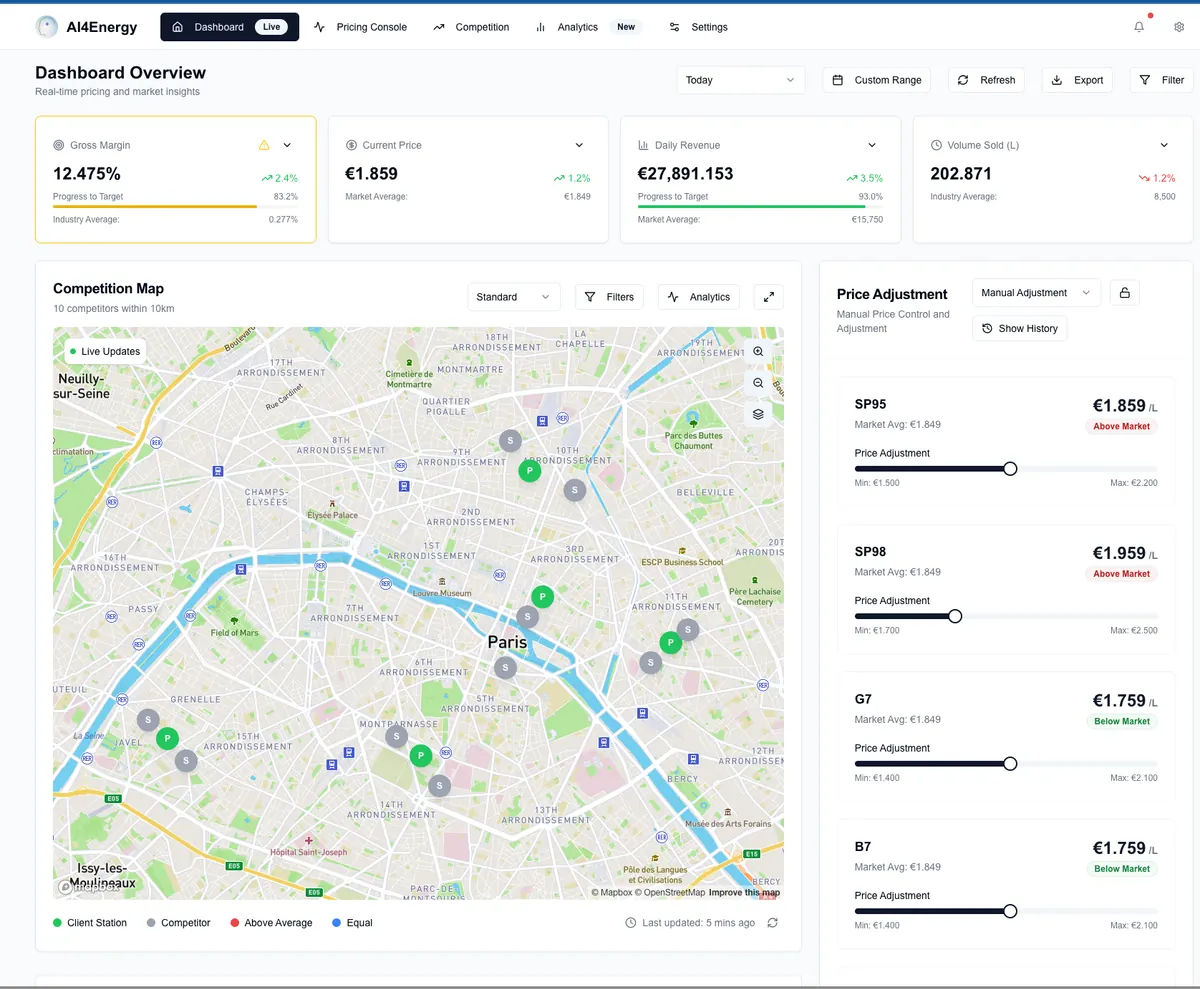
Pricing for fuel stations. A station manager sees their own prices beside every competitor nearby on a map, gets a recommended price for each fuel from a forecast of where the local market is heading, and can set rules that reprice automatically when competitors move.
- Status
- On hold
- Role
- Full-stack engineer: built the dashboard, the API and the forecasting service
- Timeline
- Nov 2024 – Feb 2025
Built with
- Next.js
- TypeScript
- Django
- FastAPI
- statsmodels
- Leaflet
- Recharts
The evidence
My part
Full-stack engineer: built the dashboard, the API and the forecasting service
- Built the dashboard in Next.js and TypeScript: overview, analytics, a pricing console and automated rules
- Built the competitor map: every station nearby with its latest price for each fuel
- Built the pricing console: current price, the competition and the recommended price side by side, ready to apply
- Built automated pricing rules: conditions on competitors' prices and the action to take, switched on and off per rule
- Built the API in Django: stations with their locations, fuel prices over time and recommended prices
- Built the forecasting service in FastAPI with statsmodels: an autoregressive model that predicts the next price from recent history
What changed.
What it achieved so far.
Competitor prices, forecasts and recommended prices on one s
Rules that reprice without a manager watching
Two versions: the second rebuilt the dashboard around the ma
Chapter 01
The problem
A fuel station's price is set against the stations around it, and those prices change several times a week. Managers check them by driving past or by phoning around, then guess. Price too high and drivers go next door; too low and the margin goes.
Chapter 02
How it works
The map shows every competing station nearby with its latest price for each fuel. The pricing console puts the station's own price beside the competition and a recommended price, worked out from a forecast of where local prices are heading, and the manager can apply it in one step.
Rules take the routine out of it: if a named competitor drops below a threshold, match it, or stay a set amount under the local average. Each rule can be switched on or off, and the analytics page shows how prices and recommendations have moved over time.
Chapter 03
A forecast that can be explained
The forecast is a small autoregressive model: it predicts the next price from the last few. That was a deliberate choice over something larger. Fuel prices move in short, regular steps, the data per station is modest, and a manager is far more likely to act on a recommendation that follows visibly from recent prices than on a black box.
Chapter 04
Built with
Next.js, TypeScript and Tailwind for the dashboard, with Leaflet for the map and Recharts for charts. Django for the API and the price data, and a FastAPI service with statsmodels for the forecast.