AI · EdTechFull-stack
Easmark
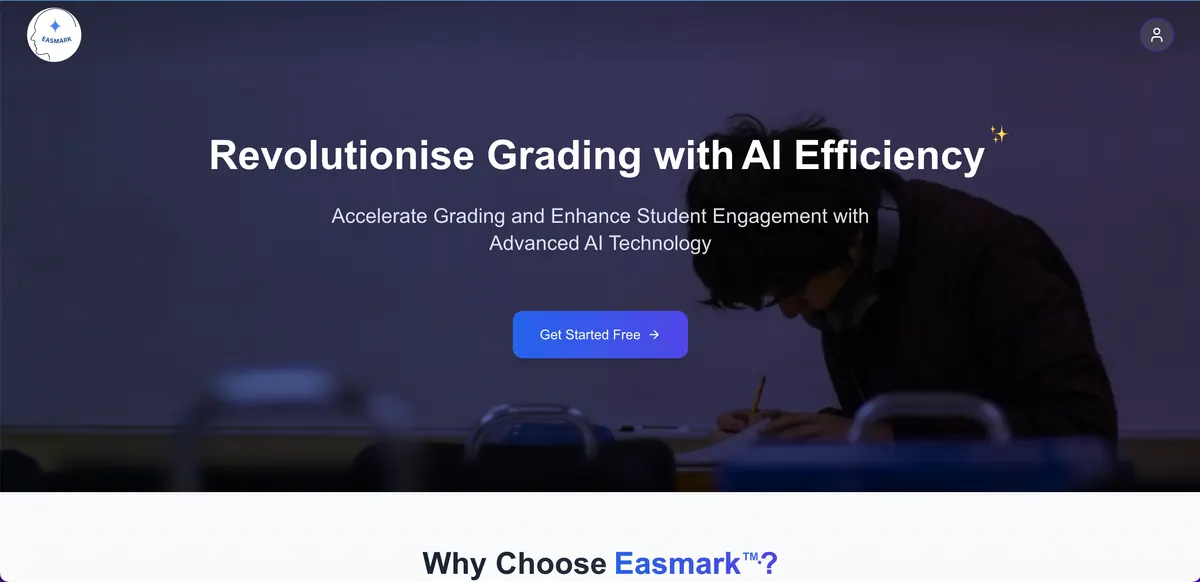
AI-assisted marking for thesis papers and code submissions, built for HitoAI. A lecturer uploads the work, Easmark marks it criterion by criterion with written feedback for each, and the lecturer reviews and adjusts the marks before anything reaches a student. Paid for with credits, so a department only pays for what it marks.
- Status
- In progress
- Built for
- HitoAI Limited
- Role
- Full-stack engineer: built all three services, the web app, the API and the AI marking service
- Timeline
- Dec 2024 – Nov 2025
Built with
- Next.js
- TypeScript
- Redux Toolkit
- Django
- FastAPI
- OpenAI
- PostgreSQL
- Stripe
- Google Cloud Run
The evidence
My part
Full-stack engineer: built all three services, the web app, the API and the AI marking service
- Designed the platform as three services: a Next.js web app, a Django API, and a FastAPI service that does the marking
- Built the marking service: it extracts text from PDF and Word files or detects the code's language, sends it to OpenAI with a rubric for that kind of work, and returns a 0–100 mark and written feedback per criterion as validated JSON
- Built the Django API: accounts for students, lecturers and institutions with email verification, marking types and prices, saved results, credits, coupons and analytics, about 75 endpoints documented in Swagger
- Built credits and payments: Stripe Checkout, a signature-verified webhook that tops up the balance, and every credit change made inside a database transaction
- Built coupons with expiry dates, usage limits, restriction to a user type, and a record of every revocation
- Built the web app: upload and marking flow, a results view where the lecturer can edit marks, summary charts, a PDF report, the credit balance and history, and the admin area
- Deployed the API to Google Cloud Run with Cloud SQL Postgres and secrets in Secret Manager; rate-limited the marking service and wrote its tests
What changed.
What it achieved so far.
Every thesis marked on 7 criteria and code on 5, each with w
Lecturers review and edit every mark before it is final
Three services: web app, Django API and AI marking service
Credits paid through Stripe, applied by a verified webhook
Chapter 01
The problem
Marking a final-year thesis properly takes hours, and a lecturer with a full class has dozens of them, plus coding assignments, in the same few weeks. The feedback suffers first: the mark goes back, the reasons behind it often don't.
Easmark doesn't take the judgement away from the lecturer. It does the first careful pass, so their time goes on deciding, not on reading the same structure problems for the fortieth time.
Chapter 02
How it works
A lecturer uploads either a thesis (PDF or Word) or a code submission (Python, JavaScript, HTML and CSS, notebooks, config files). Before anything runs, Easmark shows what the marking will cost in credits and applies any coupon they hold.
The file goes to the marking service. A thesis gets a separate mark out of 100 and written feedback for each of seven criteria: abstract, introduction, literature review, methodology, results, conclusions and references. Code is marked on readability, functionality, efficiency, error handling and modularity.
The lecturer reads the result, edits any mark they disagree with, and saves it. A summary with charts can be downloaded as a PDF report to file or send to the student.
Chapter 03
Feedback that shows its working
The most important decision was to mark criterion by criterion, not to produce one overall grade. A single AI score is hard to trust and impossible to argue with. A mark per criterion with the reason beside it is something a lecturer can check in a minute, agree with or correct, and pass on to a student as feedback they can act on.
The marking service asks the model for that exact structure, in JSON mode, with a rubric written for each kind of work, and rejects anything that doesn't parse. Nothing is final until the lecturer has reviewed it, which is the difference between a tool a department will adopt and one it will ban.
Chapter 04
Three services, one job each
The web app is Next.js. The Django API owns everything that must be right: accounts, saved results, credits, coupons and analytics. The marking service is a separate FastAPI app that reads the file, talks to OpenAI and returns marks. Keeping it separate means it can be rate-limited, scaled and changed (I rebuilt it in November 2025) without touching accounts or money.
Chapter 05
Paying for it
Departments buy marking in different ways, so Easmark runs on credits, not a flat subscription. Each kind of marking has its own price; a user buys credits through Stripe Checkout, and Stripe's webhook, verified by its signature, tops up their balance. Every change to a balance happens inside a database transaction, so a marking and its charge either both happen or neither does.
Coupons cover pilots and institutional deals. An admin creates a coupon for a type of user (students, lecturers or institutions), assigns it with an expiry date and a usage limit, and can revoke it with a reason that is kept on record.
Chapter 06
Built with
Next.js and TypeScript with Redux Toolkit Query on the front end. Django 5 and Django REST Framework with JWT, Stripe and Swagger for the API, running on Google Cloud Run with Cloud SQL Postgres and Secret Manager. FastAPI with OpenAI (gpt-4o-mini), PyPDF2 and python-docx for the marking service, with rate limiting, structured logging and pytest.