Backend · APIBackend / API
Easmark API
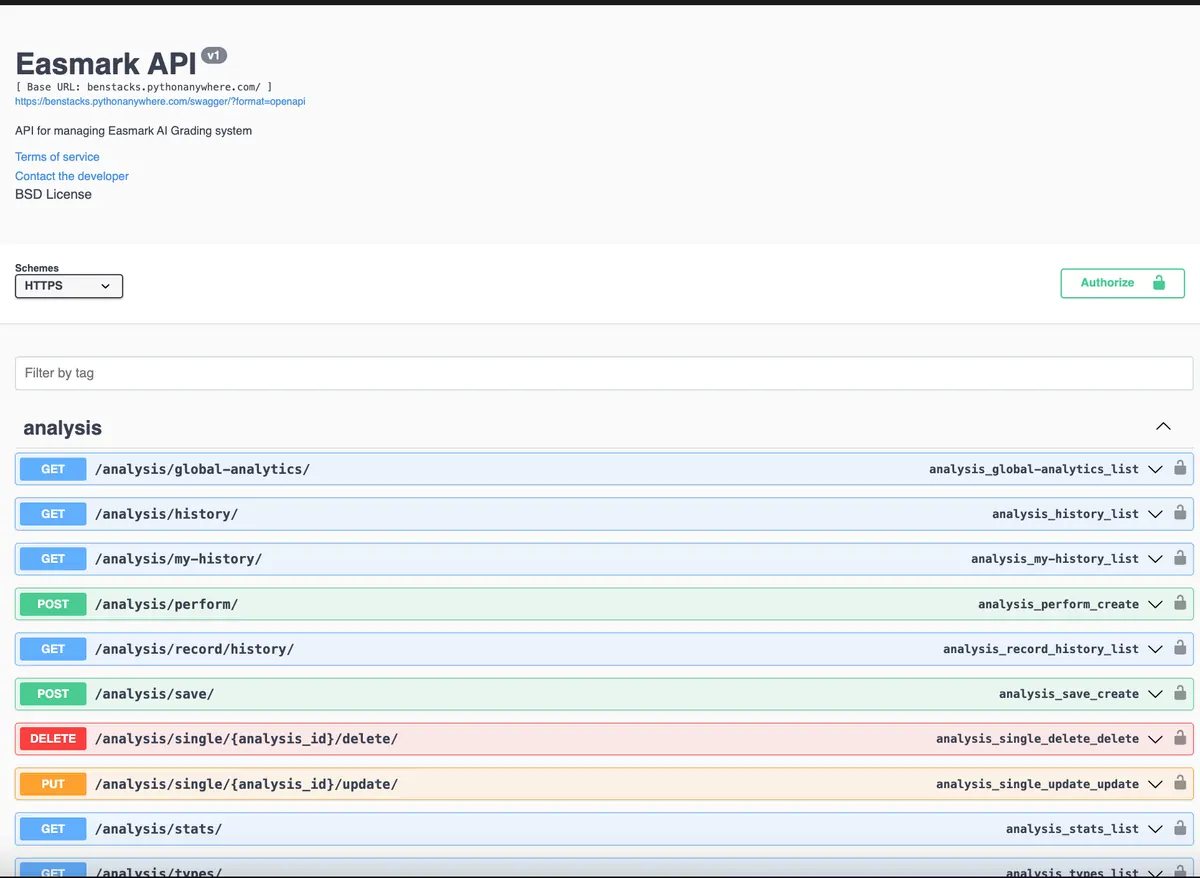
The API behind Easmark, and the AI service that does the marking. The Django API holds accounts, marking types and prices, saved results, credits, payments, coupons and analytics; the FastAPI service turns an uploaded thesis or code file into marks and written feedback with OpenAI.
- Status
- Discontinued
- Built for
- HitoAI Limited
- Role
- Back-end engineer: built the Django API and the AI marking service
- Timeline
- Dec 2024 – Nov 2025
Built with
- Django
- Django REST Framework
- FastAPI
- OpenAI
- PostgreSQL
- Stripe
- JWT
- Google Cloud Run
The evidence
My part
Back-end engineer: built the Django API and the AI marking service
- Built the Django API in five apps (users, profiles, analysis, credits and coupons): about 75 endpoints and 8,000 lines of Python, documented in Swagger
- Built accounts for students, lecturers and institutions: sign-up with a six-digit email code, JWT sign-in, password reset and admin roles
- Built credits: Stripe Checkout sessions, a signature-verified webhook, usage and payment records, pricing tiers, and balances changed only inside database transactions
- Built coupons: per-user assignments with expiry and usage limits, restriction by user type, and revocation with a recorded reason
- Built analytics per user, per marking type and across the platform
- Built the AI marking service in FastAPI: file checks, text extraction from PDF and Word, language detection for code, rubric prompts, OpenAI in JSON mode, rate limiting, structured logs and tests
- Deployed the API to Google Cloud Run with Cloud SQL Postgres and Secret Manager, falling back to SQLite for local development
What changed.
What it achieved while it ran.
About 75 endpoints across five Django apps
Marks returned as validated JSON, per criterion
Rate limit of 10 markings a minute per client
Credits applied by a verified Stripe webhook
Chapter 01
Two services
Easmark's back end is split by what can go wrong. The Django API owns anything that must be correct and permanent: who a user is, what they have paid, what they have used, and the results they saved. The AI service owns the slow, expensive, unpredictable part: reading a file and asking a model to mark it. Either can change or scale without the other.
Chapter 02
Marking a file
The AI service checks the file's type and size (up to 50 MB), extracts the text from a PDF or Word document or detects the programming language of a code file, and builds a prompt from a rubric for that kind of work: seven criteria for a thesis, five for code. It calls OpenAI in JSON mode and validates the reply against a schema, so the app always receives a mark out of 100 and feedback for every criterion, or a clear error. Requests are rate-limited per client, and every step is logged in structured JSON.
Chapter 03
Money that adds up
Buying credits creates a Stripe Checkout session; when Stripe confirms the payment, a webhook verified by its signature adds the credits. Every change to a balance (a purchase, a marking, a coupon) runs inside a database transaction, and usage and payments are kept as separate records, so any balance at any moment can be reconstructed from its history.
Chapter 04
Built with
Python. Django 5 and Django REST Framework with Simple JWT, Stripe, Django email over SMTP and drf-yasg on Google Cloud Run, Cloud SQL Postgres and Secret Manager. FastAPI, Pydantic, the OpenAI SDK, PyPDF2, python-docx and SlowAPI for the marking service, tested with pytest and packaged with Docker.