AI · WhatsAppBackend / API
Jane on WhatsApp
Uri's AI employee on WhatsApp. Business owners create, design and schedule their posts by chatting with Jane, and their customers get instant, accurate answers on the business's own number, with anything Jane can't answer handed to a person.
- Status
- Live
- Built for
- Uri
- Role
- CTO: wrote all the application code for both services
- Timeline
- Nov 2025 – present

Built with
- Python
- FastAPI
- Celery
- Redis
- nginx
- Twilio
- WhatsApp Cloud API
- OpenAI
The evidence
My part
CTO: wrote all the application code for both services
- Reviewed and supervised all of it as CTO: where a colleague built the backend, it was built under my review; I revamped the interface and fixed most of the bugs
- Wrote all the application code in both services: the conversation engine, graphics, scheduling, credits, the reply engine, routing between businesses, and escalation
- Split WhatsApp out of the main backend so it scales on its own: webhooks acknowledge at once and queue the work
- Built a conversation engine with about 30 states and session memory, so owners can type naturally
- Built the reply engine that answers customers only from the brand's own facts and escalates the rest
- Encrypted customers' phone numbers with their own key, decryptable in two places only, and purged after a retention window
- Ran a security and money audit in July 2026: found and fixed 15 issues, 5 of them critical, and removed about 1,700 lines of dead code
- Set the target architecture for the move to containers; a colleague built the deploy pipelines under my review
What changed.
Measured in production, not in a demo.
15 issues fixed in the July 2026 audit, 5 critical
3 webhook replicas and worker pools per service
~30 conversation states with session memory
Reply engine: 43 tests, all passing
Chapter 01
The problem
Many of Uri's customers run their business from their phone, and WhatsApp is where they already are; opening a web dashboard is a step too far. Their own customers ask the same questions all day (prices, delivery, opening hours) on WhatsApp, often when the owner can't reply.
Chapter 02
Under my review
As CTO I review every change to Uri's code. Where a colleague built a part, they built it under my review and supervision. I also led the revamp of the interface and fixed most of the bugs. Uri began as Uri Creative in November 2025, and this product grew out of that work.
Chapter 03
Two services, on purpose
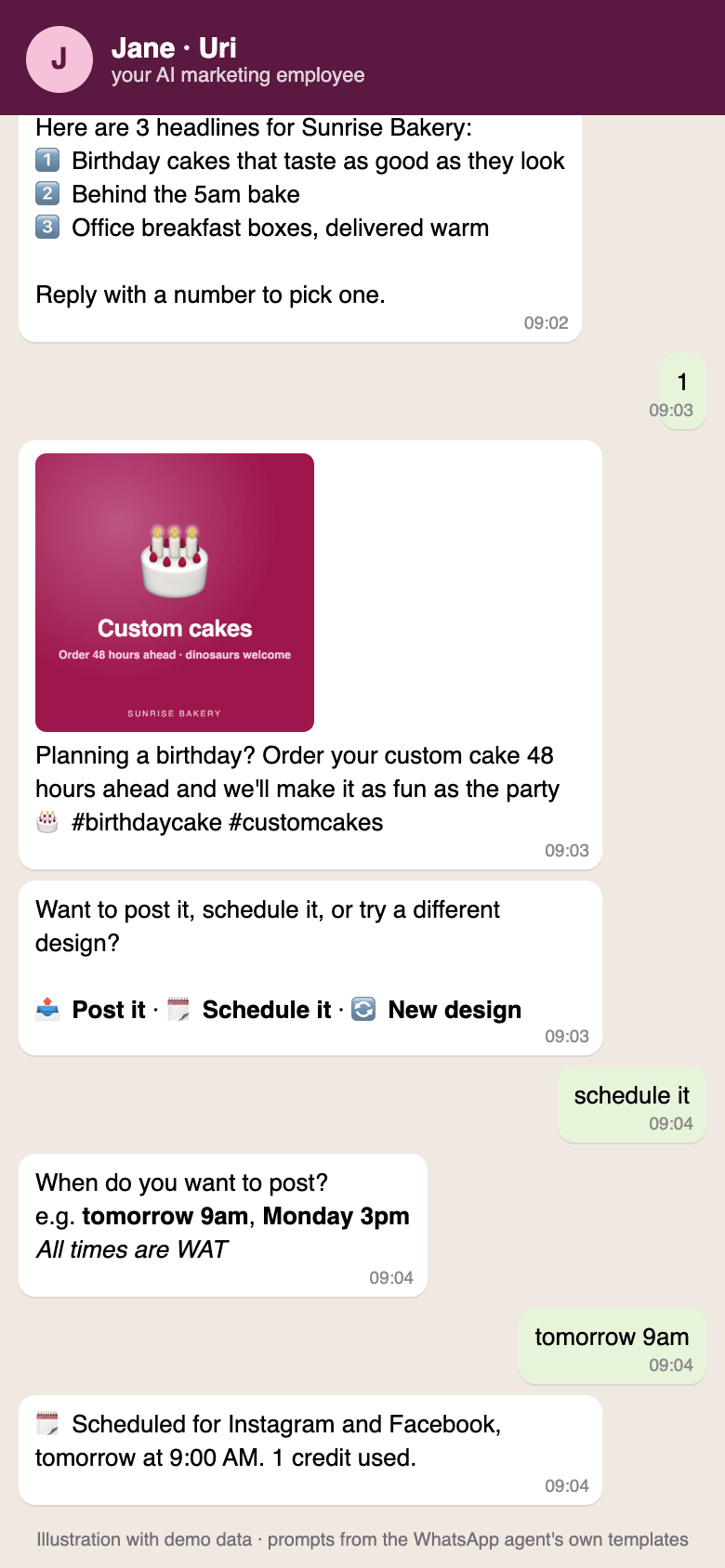
The WhatsApp agent is for owners: they ask Jane for ideas, posts and branded graphics in their brand's voice, edit or regenerate them, use their own photos, and post now or schedule ("tomorrow 9am"). Every morning at 9 Jane sends ideas, and credits, upgrades and a link to the dashboard are all a message away.
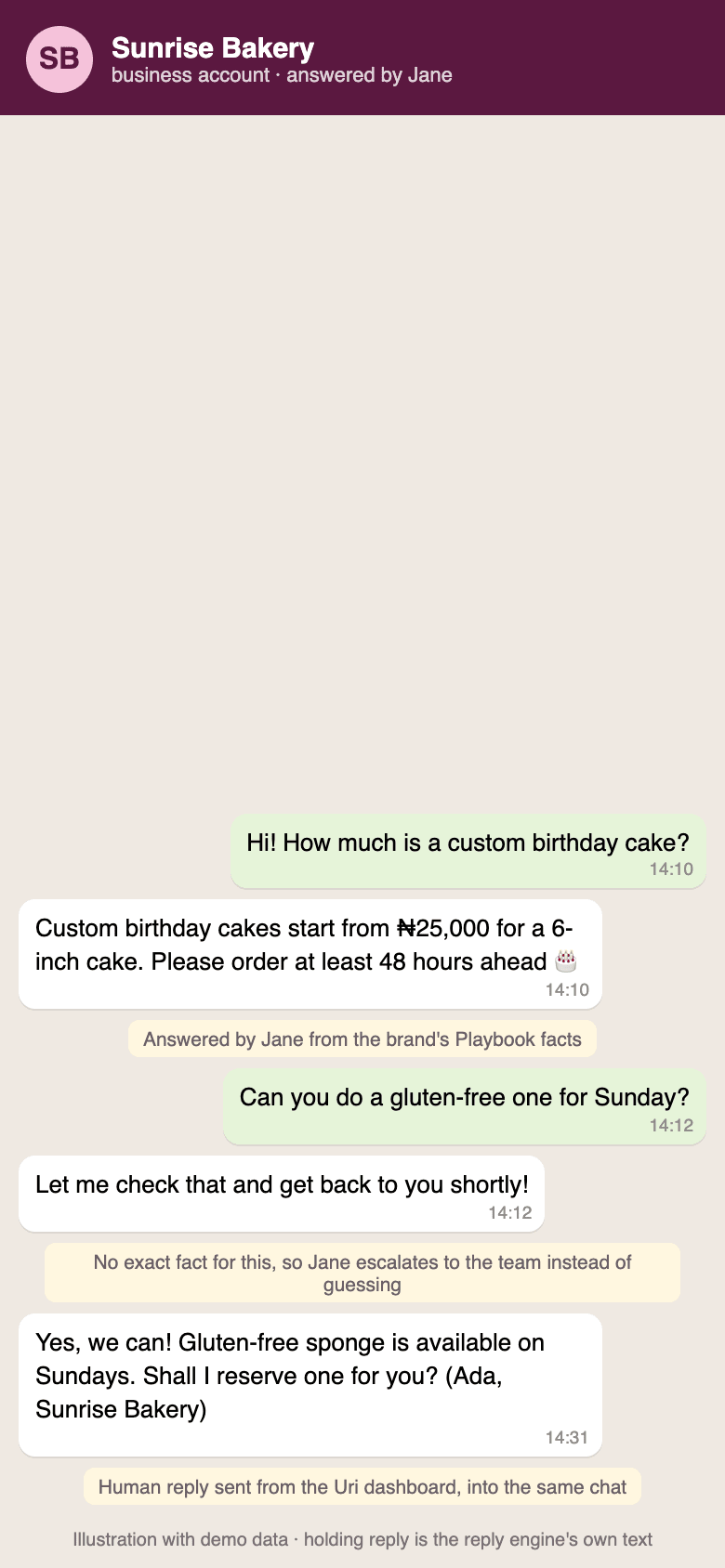
The reply engine is for the business's customers, on the business's own number. It answers only from facts in the brand's Playbook, so it never invents a price or a policy. When there is no exact answer, the customer gets a holding reply and the team gets an escalation; they reply from the Uri dashboard or by email, into the same chat.
They are separate services because they differ in everything that matters: one Uri number against each business's own, an owner creating content against a stranger asking about prices, and the size of the damage when something goes wrong. A wrong answer in the reply engine hurts a client's reputation with their own customer.
Chapter 04
Built to take a spike
Behind nginx, three webhook replicas acknowledge every message immediately and queue it in Redis; Celery worker pools do the slow AI work, and a scheduler sends the daily messages. Providers never time out and retry, slow generation never blocks new messages, and a rush of chats can't slow down the web app. Both services share the web app's database, so a brand is the same brand everywhere.
Chapter 05
Answers that can't be wrong
In its first version the reply engine only answers on an exact match against the brand's own facts and escalates everything else. More questions reach a person, but the AI never states a wrong price to someone's customer. Customers' numbers have to be recoverable to reply later, so they are encrypted rather than hashed, with their own key, decryptable in exactly two places, and purged after a retention window.
Chapter 06
The audit
In July 2026 I audited both services for security and money handling. I found and fixed 15 issues, five of them critical, including an unauthenticated scheduler endpoint, a webhook that crashed on bad signatures, a path that could publish across businesses, a race when linking phone numbers, and charges that weren't refunded when generation failed. Each fix was checked against production, read-only, before and after.
Chapter 07
Built with
Python and FastAPI, Celery and Redis, Motor on the shared MongoDB, nginx and Docker Compose; Twilio for the owners' channel and Meta's WhatsApp Cloud API for business numbers; OpenAI models for text and images; GitHub Actions deploying to containers.
More of Jane on WhatsApp.
The owner's side: content by chat. Illustration with demo data. The customer's side: answers from the Playbook, and a hand-off to a person.