Web3 · PaymentsHackathon
RealPayTag
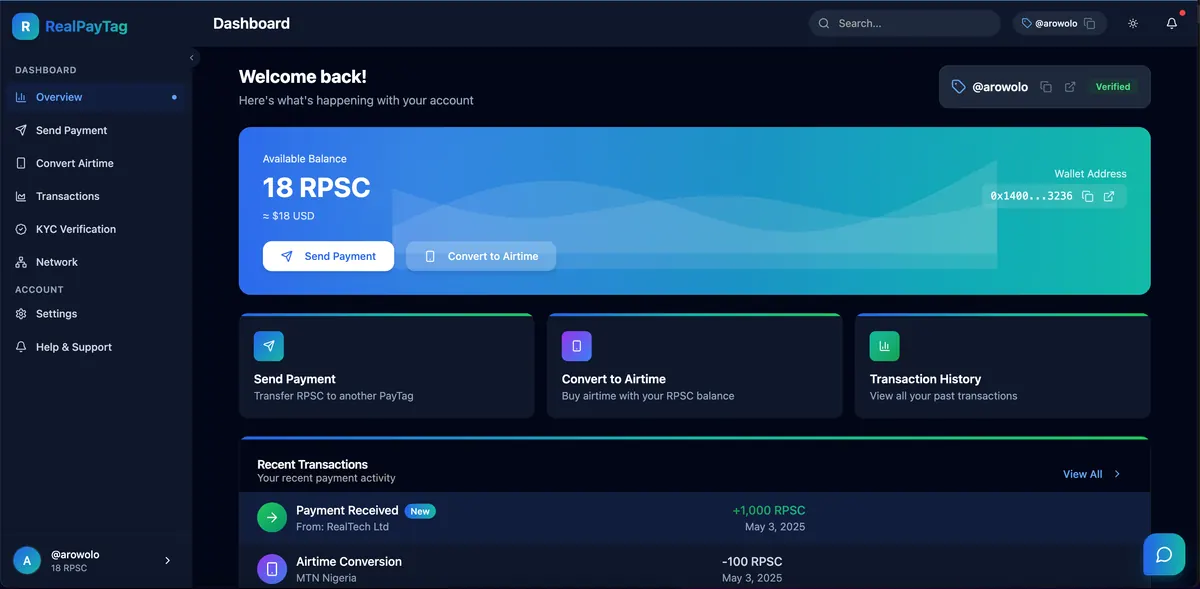
Payments and payroll on the Pharos blockchain with a stablecoin. Each person gets a PayTag, a short @name in place of a wallet address; employers run payroll in the stablecoin; users can convert mobile airtime into it and register real-world assets such as property or vehicles.
- Status
- Live
- Role
- Full-stack engineer: built the web app and the API; a teammate wrote the contracts
- Timeline
- Apr – May 2025
Built with
- Next.js
- TypeScript
- Node.js
- Express
- Solidity
- Hardhat
- Pharos
The evidence
My part
Full-stack engineer: built the web app and the API; a teammate wrote the contracts
- Built the web app in Next.js and TypeScript: onboarding, separate dashboards for users and employers, and pages for PayTags, payroll, the stablecoin, airtime and assets
- Built onboarding so a new user claims their @PayTag as part of signing up
- Built the API in Node.js, Express and TypeScript behind the app
- Connected the app to the contracts on Pharos devnet: claiming a PayTag and adding employees go on-chain from the browser
What changed.
Measured in production, not in a demo.
Five contracts with about 85 tests behind one app
Pay anyone by @name instead of a wallet address
Separate dashboards for individuals and employers
Chapter 01
The problem
In much of Africa, getting paid sits between slow bank transfers and crypto that is volatile and hard to use. Wallet addresses are unreadable, salaries can't easily be paid in crypto, and many people hold value as mobile airtime rather than in a bank.
Chapter 02
How it works
Everyone claims a PayTag when they sign up, so paying someone means typing @name rather than pasting an address. Money moves in a stablecoin, which keeps its value. Employers register their staff and run payroll from the employer dashboard; salaries are paid in the stablecoin on schedule.
Airtime can be converted into the stablecoin at a rate set per network, which turns a common store of value into something that can be spent anywhere. Real-world assets such as property and vehicles can be registered, verified and transferred on the asset registry.
Chapter 03
Built with
Next.js, TypeScript and Tailwind for the app; Node.js, Express and TypeScript for the API; Solidity and Hardhat for the contracts, written by my teammate Arowolo Kehinde and deployed to Pharos devnet.